Top 10 DTF manufacturers in China
Top 10 DTF manufacturer in China
More
Film DTF transfer presents a profitable opportunity for small businesses seeking versatile, vibrant prints in 2026. A company's final decision, however, hinges on a practical assessment of its capabilities. Business owners must evaluate four critical factors:
Cost and potential profit
Available workspace and environment
Production volume goals
Specific quality requirements
This analysis ensures the investment aligns with their unique business objectives.
A business owner must look beyond the initial printer price to grasp the full financial picture of a film dtf transfer setup. Ongoing operational expenses are a significant part of the total investment.
A comprehensive financial plan accounts for recurring monthly expenditures. For a small operation, these costs can range from $200 to $800. Business owners should budget for several key areas:
Consumables: Each 8"x10" print requires ink ($0.60-$1.00), film ($0.40-$0.60), and powder ($0.15-$0.25).
Maintenance: Weekly tasks like print head cleaning and system calibration add up.
Utilities: Increased electricity and HVAC usage for a controlled environment can add $150 to $450 monthly.
Note: These figures provide a baseline. Actual costs will vary based on production volume and equipment efficiency.
Understanding costs allows a business to accurately calculate its return on investment (ROI). This calculation determines how quickly the film dtf transfer equipment will pay for itself and start generating profit. A business can follow a simple, three-step process:
Determine Net Profit Per Hour: Subtract all production and labor costs from hourly gross sales.
Estimate Monthly Profits: Multiply the net profit per hour by the total operational hours per month.
Identify the Break-Even Point: Calculate the hours needed to operate each month to cover all fixed and variable costs.
The table below shows how different factors influence this break-even point.
| Cost Component | How It Affects Break-Even Point |
|---|---|
| Fixed Costs | Higher fixed costs increase the break-even point. |
| Variable Costs | Higher variable costs lower the profit per unit, raising the break-even point. |
| Sales Price | Raising the sales price can lower the break-even point. |
A realistic assessment of these numbers reveals if the investment aligns with the company's financial goals.
Beyond financial planning, a business must assess its physical space and operational capacity. A DTF setup has specific environmental and labor requirements that directly impact its success. A failure to plan for these practical needs can lead to production delays and quality issues.
A DTF printing operation requires more than just a spot for the printer. A business owner needs a dedicated, controlled environment. A minimum of a 10'x10' room is often necessary to accommodate the printer, a powder/shaker unit, and a heat press. The environment itself is critical for consistent results. Owners must plan for:
Ventilation: The powdering and curing process creates fumes. An effective fume extraction system is non-negotiable for employee safety and air quality. (fumes emoji)
Temperature and Humidity: DTF printers operate best within a stable temperature range (65-75°F) and humidity level (40-60%). Fluctuations can cause ink clogs and film warping.
Cleanliness: The space must be kept clean and dust-free. Dust and debris can contaminate the adhesive powder, leading to flawed prints.
DTF printing is a multi-step process that demands both time and technical skill. It is not a fully automated, "push-button" solution. An operator handles tasks from file preparation in RIP software to printer maintenance and final heat pressing.
The learning curve for DTF is manageable but requires dedication. An operator must learn to troubleshoot common issues like color shifts, clogged nozzles, and powder application errors.
The daily workflow involves printing, applying powder, curing the film, and pressing the transfer. Each step adds to the total production time per garment. A business must factor this hands-on labor into its production schedule and cost calculations to ensure the workflow remains efficient and profitable.

Choosing the right printing method depends on a business's specific needs. DTF offers a unique balance of quality, versatility, and efficiency compared to other popular options.
DTF printing provides greater material versatility than DTG. While DTG excels on 100% cotton, it struggles with polyester and blended fabrics. DTF, however, prints vibrant designs on cotton, polyester, blends, and even hard surfaces. DTG printers often require a larger initial investment and a more involved pretreatment process for garments. DTF simplifies this workflow, making it a more flexible choice for businesses serving diverse markets.
Screen printing is the industry standard for very large bulk orders. For small to medium-sized runs with multiple colors, DTF is more efficient. Screen printing requires significant setup time for each color, which increases costs on smaller jobs. The table below illustrates the advantage of DTF for a medium-sized order.
| Feature | DTF Printing | Multi-color Screen Printing |
|---|---|---|
| Setup Time | No setup time | 30-60 minutes per design |
| Cost per piece (50-100 units) | $1.05 - $1.95 | $1.50 - $2.80 |
This data shows that DTF can offer 20-40% savings on these orders.
The film dtf transfer process is significantly faster than using HTV for complex or bulk orders. HTV requires operators to manually "weed," or remove, excess vinyl from each design, a time-consuming step that DTF eliminates. This speed difference is a major factor for production efficiency. (lightning bolt emoji)
| Printing Method | Production Speed |
|---|---|
| DTF Printing | Fast for bulk orders, no weeding required |
| HTV Printing | Slower due to the necessity of weeding |
Additionally, DTF prints have a softer feel on the garment compared to the often thick, plastic-like texture of layered HTV.
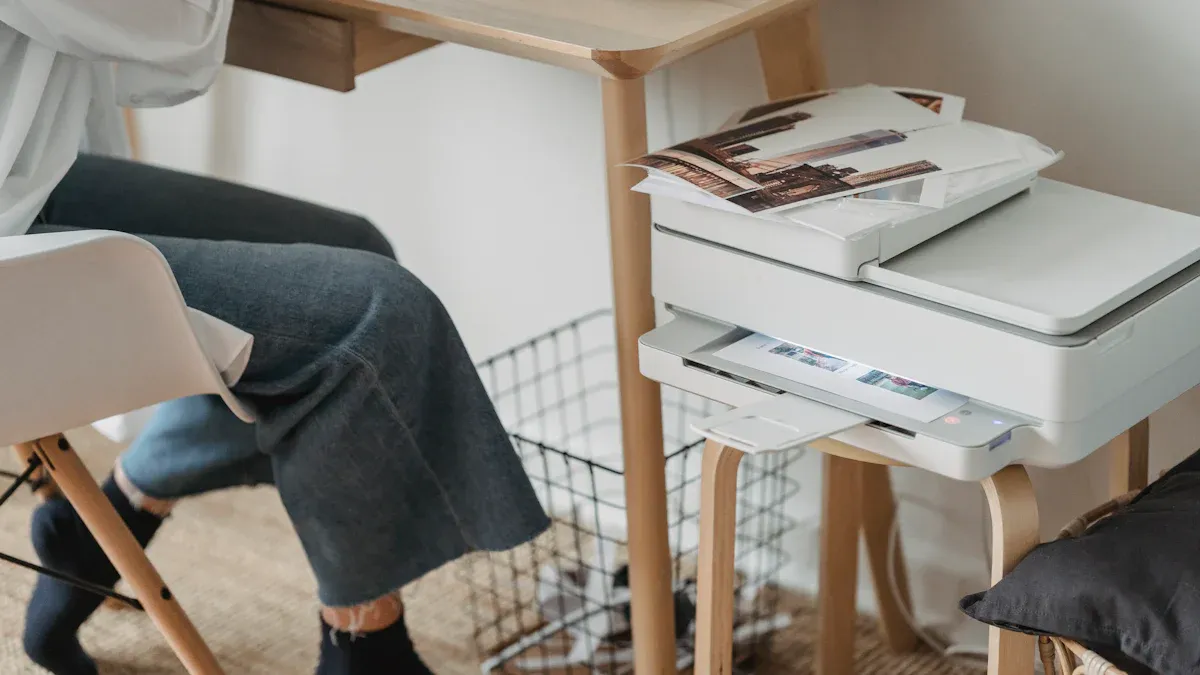
Selecting the right DTF printer is a critical decision that shapes a business's production capabilities. The market in 2026 offers options for every budget and volume need. A business owner should evaluate each printer based on its initial cost, output capacity, and long-term support.
The Epson L1800 remains a popular entry point for businesses testing the DTF market. This model is not a dedicated DTF printer. Instead, technicians convert this A3+ photo printer for DTF use. The primary appeal is its low initial cost, often under $1,000 for the printer itself.
This path requires significant technical skill. The owner is responsible for the conversion, which includes installing a custom ink system and using specialized RIP software. Maintenance is entirely manual and frequent. Clogs and banding are common issues that demand constant attention.
Pro Tip: The L1800 conversion offers the lowest financial barrier to entry. However, a business trades cost savings for reliability and support. The lack of a warranty and the steep learning curve make it suitable only for owners with a strong DIY aptitude.
The XTOOL Apparel Printer represents a significant step up from DIY conversions. It is an all-in-one system designed specifically for small to medium-sized apparel businesses. This printer integrates the printing and powdering/curing processes into a single, compact unit, streamlining the workflow.
This model provides a balance of affordability and professional features. It offers greater reliability and consistency than a converted printer. The automated powder application and curing save valuable time and reduce material waste. This makes it an excellent choice for businesses ready to increase their production volume without committing to a large industrial machine.
| Feature | XTOOL Apparel Printer | DIY Conversion (e.g., L1800) |
|---|---|---|
| System Type | Integrated All-in-One | Separate, Manual Components |
| Workflow | Automated Printing & Curing | Manual Powdering & Curing |
| Support | Manufacturer Warranty & Support | No Warranty, Community Support |
| Ideal User | Growing business needing efficiency | Hobbyist or starter on a tight budget |
The Coldesi 12H2 is a commercial-grade machine engineered for small shops with consistent, high-volume orders. This printer is a robust workhorse built for daily production runs. Its dual print heads enable faster printing speeds and superior white ink opacity in a single pass. (rocket emoji)
The machine's output capacity is its main selling point. The ColDesi 12H2 DTF printer can produce approximately 50, 8"x10" transfers per hour. This rate allows for a maximum production volume of 1200 transfers over a 24-hour period, empowering a shop to take on larger and more frequent orders.
The investment in a Coldesi 12H2 includes a comprehensive support and training package. This ensures operators can maximize the machine's potential and minimize downtime. The training covers every aspect of the DTF process:
Printer and Dryer Setup
Software Installation and Features (Print EXP, Print Optimizer)
Printer Adjustments and Calibration
Executing the First Print Job
Daily and Weekly Maintenance Procedures
Standard Operating Procedures for Efficient Workflow
This level of support is invaluable for a business that depends on its equipment to generate revenue. It transforms a simple purchase into a long-term production partnership.
A business owner must answer a final checklist before investing.
Can the business afford the initial and ongoing costs? Is there adequate, well-ventilated space? Do production goals justify the investment?
Answering "yes" confirms film dtf transfer is a powerful scaling tool. The ROI is significant for those with consistent orders, but the initial investment remains the biggest hurdle for newcomers.
DTF prints offer excellent durability. They withstand dozens of washes without cracking or fading. Proper application ensures a long-lasting, high-quality finish on the garment.
Daily maintenance is crucial for performance. Operators must perform a nozzle check and clean the print head. Shaking the white ink is also a necessary daily task.
Yes, DTF excels on dark polyester fabrics. The white ink underbase ensures colors appear vibrant and opaque. This makes it a superior choice over many other methods.



Select the most popular foreign trade service products to meet your diverse needs
Select the most popular foreign trade service products to meet your diverse needs

Tel: +86 17706217416
Add: Building L2A, No. 520, Lane 1588, Zhuguang Road, Hongqiao World Center, Qingpu District, Shanghai, China






User Comments
Service Experience Sharing from Real Customers
Michael Rodriguez
Apparel Shop OwnerThe film DTF transfers are a game-changer for our custom t-shirt business. The colors are incredibly vibrant, the hand-feel is soft, and the durability after multiple washes is outstanding. Perfect for small batches and detailed designs.
Sarah Chen
Marketing CoordinatorUsed these film DTF transfers for a company event giveaway. The print quality was excellent and professional-looking. Setup was straightforward, and we got great feedback on the comfort of the shirts. Will definitely order again for our next campaign.
David Miller
High School Art TeacherThese transfers are fantastic for our student art projects. They allow us to print complex, full-color designs from the classroom printer and apply them to fabric easily. The results are impressive and really motivate the students. Highly recommended for educational use.
Jessica Williams
Small Business OwnerAs a startup selling branded merchandise, the quality and consistency of these DTF films are crucial. They have never let me down. The whites are bright, the detail is sharp, and the transfer process is reliable. Excellent product that helps my business look professional.